
Sustainable Yacht Design Explained: Innovations for Luxury
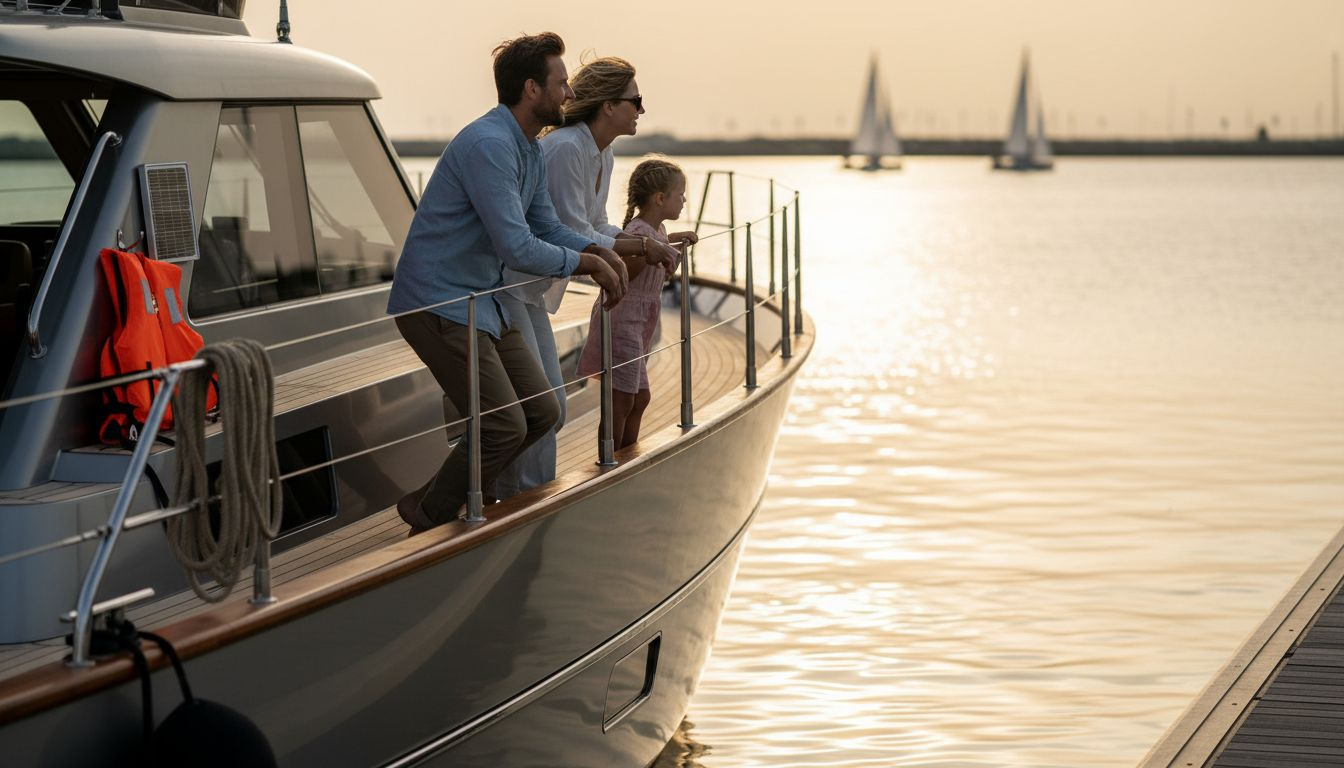
Luxury yacht ownership now comes with new expectations. As global environmental consciousness rises, forward-thinking owners are seeking more than extravagant interiors and sleek performance. There is growing interest in sustainable yacht design, which fuses advanced technology with ecological responsibility to safeguard the world’s oceans. This guide explores the principles and innovations that are transforming yacht design, showing how today’s most bespoke vessels combine eco-friendly materials, renewable energy systems, and intelligent engineering that set new standards in both luxury and sustainability.
Table of Contents
Key Takeaways
Point | Details |
Sustainable Design Principles | Emphasizes material selection, energy efficiency, and hydrodynamic optimization for reduced environmental impact. |
Innovative Technologies | Incorporates advanced propulsion systems and renewable energy integration to achieve lower emissions and improved performance. |
Advanced Materials | Utilizes lightweight, recyclable materials and bio-based resins to enhance durability while minimizing environmental footprint. |
Economic Advantages | Offers long-term cost savings, increased resale value, and reduced maintenance for yacht owners while aligning with sustainability goals. |
Defining Sustainable Yacht Design Principles
Sustainable yacht design represents a complex intersection of technological innovation, environmental consciousness, and luxury performance. At its core, this approach demands reimagining maritime engineering through the lens of ecological responsibility. Sustainable yacht design goes beyond mere aesthetic considerations, focusing on reducing environmental impact while maintaining exceptional performance standards for discerning yacht owners.
The fundamental principles of sustainable yacht design center on three critical domains: material selection, energy efficiency, and hydrodynamic optimization. Fluid dynamic design principles demonstrate how computational modeling can dramatically improve hull efficiency, reducing fuel consumption and minimizing marine ecosystem disruption. Designers now leverage advanced technologies to create vessels that minimize drag, optimize propulsion systems, and integrate renewable energy sources seamlessly.
Key sustainable design strategies include:
Utilizing lightweight composite materials with low environmental manufacturing footprints
Implementing solar and wind energy integration systems
Designing hulls with advanced hydrodynamic profiles that reduce energy consumption
Selecting propulsion technologies with minimal carbon emissions
Creating modular design approaches that extend vessel lifecycle and reduce waste
Pro tip: When considering a sustainable yacht design, prioritize naval architects who demonstrate a proven track record of integrating ecological principles with cutting-edge technological innovation.
Key Innovations in Eco-Friendly Yachts
The evolution of eco-friendly yacht design represents a groundbreaking transformation in maritime engineering, where technological innovation meets environmental stewardship. Modern yacht designers are pushing the boundaries of sustainable maritime technology, developing solutions that dramatically reduce ecological impact without compromising luxury or performance. These innovations span multiple domains, from propulsion systems to material selection and energy management.
Renewable propulsion systems are revolutionizing yacht design, enabling vessels to achieve near-zero emissions through advanced integration of solar, wind, and hydrokinetic energy technologies. These cutting-edge approaches can reduce carbon emissions by up to 85%, representing a significant leap forward in sustainable maritime transportation. By leveraging battery-electric drives and sophisticated energy management systems, yacht designers are creating vessels that balance high-performance capabilities with minimal environmental footprint.
Key innovations in eco-friendly yacht design include:
Advanced photovoltaic panel integration with seamless aesthetic design
Hybrid electric-hydrogen propulsion systems
Lightweight, recyclable composite materials
Smart energy storage and management technologies
Regenerative power systems that capture and reuse onboard energy
Hull designs optimized for maximum hydrodynamic efficiency
Pro tip: When exploring eco-friendly yacht options, prioritize naval architects who demonstrate comprehensive understanding of both technological innovation and environmental sustainability.
Advanced Materials and Construction Choices
The landscape of yacht construction has undergone a radical transformation, driven by the imperative to create vessels that are not just luxurious, but fundamentally sustainable. Advanced parametric modeling techniques have revolutionized how naval architects approach material selection and structural design, enabling unprecedented precision in developing high-performance, environmentally conscious yacht structures.
Modern sustainable yacht construction prioritizes materials that offer exceptional performance with minimal ecological impact. Cutting-edge composite technologies now integrate bio-based resins, recycled carbon fibers, and advanced lightweight materials that dramatically reduce a vessel’s overall carbon footprint. These innovative materials not only provide superior strength-to-weight ratios but also enable more efficient hull designs that optimize hydrodynamic performance and fuel efficiency.

Key advanced materials transforming yacht construction include:
Here’s a comparison of advanced materials commonly used in sustainable yacht construction and their engineering benefits:
Material Type | Ecological Impact | Engineering Advantage | Lifecycle Benefit |
Recycled carbon fiber | Low manufacturing waste | High strength-to-weight | Enables better recyclability |
Bio-derived resin | Reduces fossil fuel use | Excellent corrosion resistance | Degrades more sustainably |
Nano-engineered composites | Minimal resource demand | Superior durability | Extends service life |
Thermal-adaptive materials | Energy efficient | Regulates onboard temperature | Improves overall efficiency |
Carbon fiber composites with reduced environmental manufacturing processes
Bio-derived resin systems replacing traditional petroleum-based alternatives
Recycled and recyclable structural components
Nano-engineered materials offering enhanced durability and reduced weight
Self-healing composite technologies that extend material lifecycle
Thermal-adaptive materials improving vessel energy efficiency
Pro tip: When evaluating yacht construction materials, request comprehensive lifecycle assessments that detail both environmental impact and long-term performance characteristics.
Hybrid Propulsion and Onboard Energy Solutions
The maritime industry is experiencing a transformative shift towards sustainable propulsion technologies that challenge traditional diesel-powered systems. Hybrid propulsion architectures represent a groundbreaking approach to yacht design, seamlessly integrating multiple energy sources to optimize performance, efficiency, and environmental responsibility. These innovative systems go beyond simple energy conservation, creating sophisticated networks of power generation and management that redefine maritime mobility.
Advanced hybrid propulsion solutions leverage multiple energy technologies, combining electric drives, renewable power sources, and intelligent energy management systems. Modern yacht designs now incorporate solar arrays, wind turbines, hydrogen fuel cells, and high-capacity battery banks that work in concert to provide consistent, clean propulsion. By implementing these integrated systems, yacht owners can dramatically reduce carbon emissions while maintaining the exceptional performance and luxury expected in high-end maritime vessels.
Key hybrid propulsion and energy innovations include:
Modular battery-electric drive systems with rapid charging capabilities
Regenerative energy capture from wave and wind motion
Intelligent power management algorithms
Hydrogen and solar hybrid power integration
Advanced thermal energy recovery systems
Adaptive energy storage technologies with real-time performance optimization
Pro tip: When exploring hybrid propulsion options, prioritize systems that offer seamless power transition and comprehensive energy management capabilities.
Practical Benefits for Owners and Builders
Sustainable yacht design represents more than an environmental statement—it’s a strategic investment that delivers tangible economic and operational advantages for both yacht owners and builders. Simulation-driven design approaches have revolutionized the yacht development process, enabling unprecedented levels of precision, efficiency, and performance optimization that translate directly into measurable value.
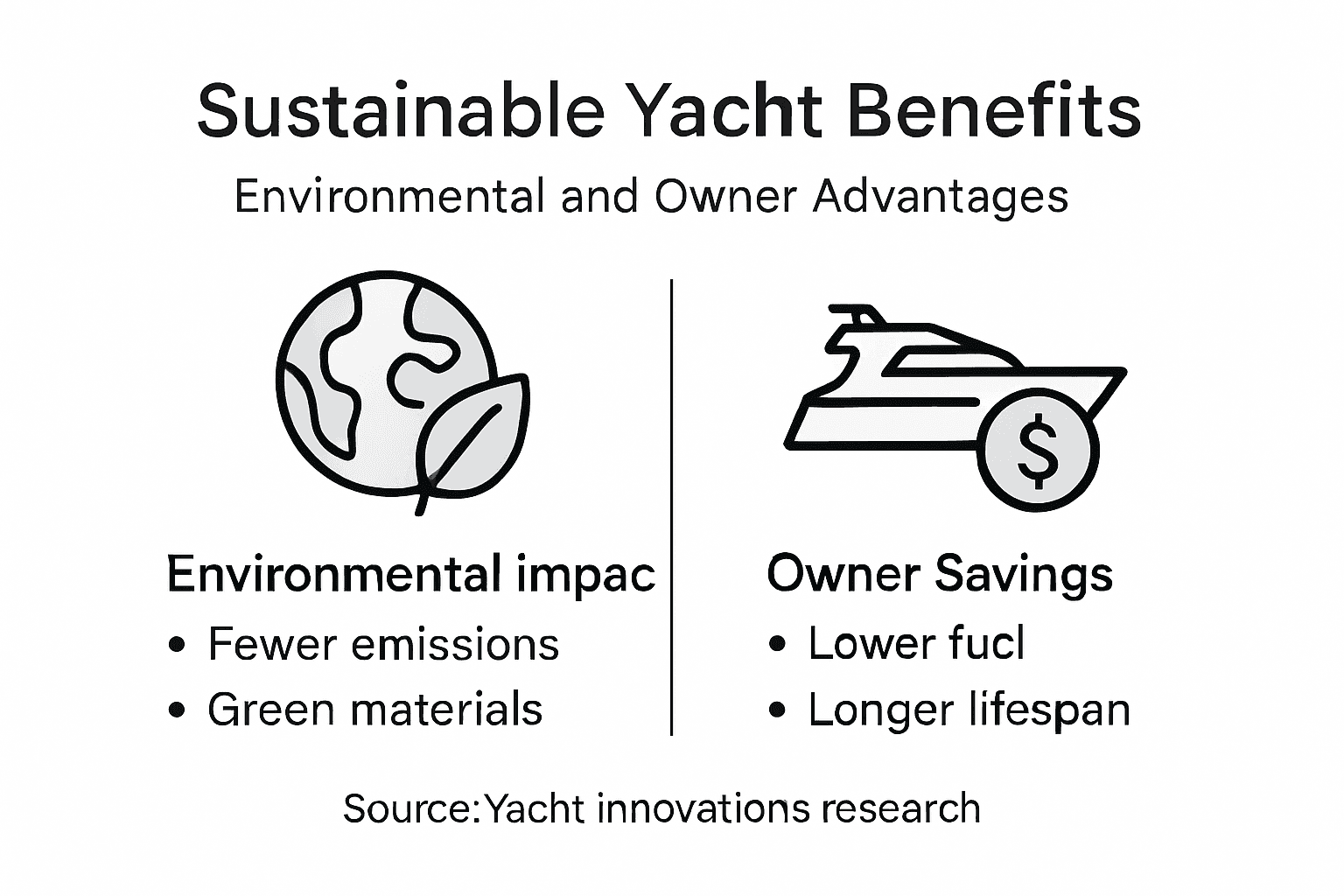
For yacht owners, sustainable design translates into significant long-term benefits. Advanced construction techniques and innovative materials reduce maintenance costs, extend vessel lifecycle, and enhance resale value. Hybrid propulsion systems and energy-efficient technologies dramatically lower operational expenses, with some owners experiencing up to 40% reduction in fuel consumption and maintenance expenditures. These technological innovations also position owners at the forefront of maritime sustainability, reflecting a commitment to environmental responsibility while maintaining uncompromised luxury and performance.
Key practical benefits for owners and builders include:
For a quick overview, here are practical benefits for owners and builders choosing sustainable yacht design:
Benefit Type | Owner Advantage | Builder Advantage |
Cost Savings | Lower fuel and maintenance bills | Reduced warranty issues |
Environmental Value | Smaller carbon footprint | Easier compliance with regulations |
Market Positioning | Higher resale and prestige value | Stronger brand reputation |
Design Flexibility | Customization options throughout lifecycle | Faster adaptation to trends |
Reduced lifecycle and operational costs
Enhanced vessel performance and efficiency
Lower environmental impact and regulatory compliance
Increased market value and competitive positioning
Improved energy independence
Greater flexibility in design and customization
Pro tip: When considering a sustainable yacht investment, request comprehensive performance modeling and lifecycle cost analyses to fully understand the long-term economic advantages.
Common Challenges and Industry Solutions
The maritime industry faces complex obstacles in transitioning toward sustainable yacht design, requiring innovative approaches to overcome deeply ingrained technological and regulatory barriers. Maritime decarbonization challenges represent a multifaceted challenge that demands coordinated technological and strategic interventions across design, manufacturing, and operational domains.
Industry leaders are addressing sustainability challenges through advanced technological solutions and strategic collaborations. These approaches include developing sophisticated computational modeling techniques, exploring alternative propulsion technologies, and creating adaptive design frameworks that can rapidly integrate emerging sustainable technologies. By leveraging open-source design tools and collaborative research platforms, yacht manufacturers can accelerate innovation cycles and reduce the economic risks associated with sustainable technology implementation.
Key challenges and corresponding industry solutions include:
High initial technology investment costs
Complex regulatory compliance requirements
Limited sustainable material availability
Performance efficiency trade-offs
Energy storage and management complexities
Technological integration and compatibility issues
Pro tip: When navigating sustainable yacht design challenges, prioritize flexible design architectures that allow for incremental technological upgrades and modular system integration.
Experience Sustainable Yacht Innovation with Opalinski Design House
The demand for sustainable yacht design brings unique challenges such as integrating eco-friendly materials, hybrid propulsion systems, and advanced energy management while preserving luxury and performance. If you seek a naval architecture studio that understands these critical pain points and crafts bespoke solutions like fold-down transoms and innovative hull designs, Opalinski Design House delivers unmatched expertise. Their proven track record in marrying sustainability with cutting-edge technology ensures your yacht not only reduces environmental impact but also stands out in prestige and efficiency.
Discover how our patented technologies and personalized approach can transform your vision into a breathtaking sustainable vessel. Visit Opalinski Design House to explore our portfolio and learn about our industry-leading innovations. Take the first step toward a future-proof yacht that redefines luxury with ecological responsibility. Contact us today to request a personalized quote and join the vanguard of sustainable yachting.
Frequently Asked Questions
What are the key principles of sustainable yacht design?
Sustainable yacht design focuses on material selection, energy efficiency, and hydrodynamic optimization. It aims to reduce environmental impact while ensuring high performance for luxury vessels.
How do hybrid propulsion systems work in eco-friendly yachts?
Hybrid propulsion systems integrate multiple energy sources such as electric drives, solar panels, and wind turbines to provide clean energy. These systems optimize power management for improved performance and reduced carbon emissions.
What are some advanced materials used in sustainable yacht construction?
Common advanced materials include recycled carbon fibers, bio-derived resins, and nano-engineered composites. These materials offer high strength with minimal ecological impact, enhancing durability and fuel efficiency.
What are the long-term benefits of investing in a sustainable yacht?
Investing in a sustainable yacht can lead to lower fuel and maintenance costs, enhanced resale value, and reduced environmental impact. These yachts often feature innovative designs that reflect a commitment to luxury and sustainability.
Recommended

Comments